Blog

COMPOSITE MACRO ETF WEEKLY ANALYTICS (5/08/2016)
PythonGlobal Markets

COMPOSITE MACRO ETF WEEKLY ANALYTICS (5/08/2016)

FOR A DEEPER DIVE INTO ETF PERFORMANCE AND RELATIVE VALUE SUBSCRIBE TO THE ETF INTERNAL ANALYTICS PACKAGE HERE LAYOUT (Organized by Time Period): Composite ETF Cumulative Returns Momentum Bar plot Composite ETF Cumulative Returns Line plot (best vs worst vs benchmark) Composite ETF Risk-Adjusted Returns Scatter plot (Std vs Mean) Composite ETF Risk-Adjusted Return Correlations Heatmap (Clusterplot) Implied Cost of Capital Estimates Composite ETF Cumulative Return Tables Notable Trends an

READ MORE
USING IMPLIED VOLATILITY TO PREDICT ETF RETURNS (5/08/16)
PythonQuant

USING IMPLIED VOLATILITY TO PREDICT ETF RETURNS (5/08/16)

FOR A DEEPER DIVE INTO ETF PERFORMANCE AND RELATIVE VALUE SUBSCRIBE TO THE ETF INTERNAL ANALYTICS PACKAGE HERE To see the origin of this series click here In the paper that inspired this series "What Does Individual Option Volatility Smirk Tell Us About Future Equity Returns" the authors' research shows that their calculation of the Option Volatility Smirk is predictive of equity returns up to 4 weeks. Therefore, each week, I will calculate the Long/Short legs of a portfolio constructed by fol

READ MORE
USING IMPLIED VOLATILITY TO PREDICT ETF RETURNS (4/30/16)
PythonQuant

USING IMPLIED VOLATILITY TO PREDICT ETF RETURNS (4/30/16)

FOR A DEEPER DIVE INTO ETF PERFORMANCE AND RELATIVE VALUE SUBSCRIBE TO THE ETF INTERNAL ANALYTICS PACKAGE HERE To see the origin of this series click here In the paper that inspired this series "What Does Individual Option Volatility Smirk Tell Us About Future Equity Returns" the authors' research shows that their calculation of the Option Volatility Smirk is predictive of equity returns up to 4 weeks. Therefore, each week, I will calculate the Long/Short legs of a portfolio constructed by fol

READ MORE
COMPOSITE MACRO ETF WEEKLY ANALYTICS (4/30/2016)
PythonGlobal Markets

COMPOSITE MACRO ETF WEEKLY ANALYTICS (4/30/2016)

FOR A DEEPER DIVE INTO ETF PERFORMANCE AND RELATIVE VALUE SUBSCRIBE TO THE ETF INTERNAL ANALYTICS PACKAGE HERE LAYOUT (Organized by Time Period): Composite ETF Cumulative Returns Momentum Bar plot Composite ETF Cumulative Returns Line plot (best vs worst vs benchmark) Composite ETF Risk-Adjusted Returns Scatter plot (Std vs Mean) Composite ETF Risk-Adjusted Return Correlations Heatmap (Clusterplot) Implied Cost of Capital Estimates Composite ETF Cumulative Return Tables Notable Trends an

READ MORE
USING IMPLIED VOLATILITY TO PREDICT ETF RETURNS (4/24/16)
PythonQuant

USING IMPLIED VOLATILITY TO PREDICT ETF RETURNS (4/24/16)

FOR A DEEPER DIVE INTO ETF PERFORMANCE AND RELATIVE VALUE SUBSCRIBE TO THE ETF INTERNAL ANALYTICS PACKAGE HERE To see the origin of this series click here In the paper that inspired this series "What Does Individual Option Volatility Smirk Tell Us About Future Equity Returns" the authors' research shows that their calculation of the Option Volatility Smirk is predictive of equity returns up to 4 weeks. Therefore, each week, I will calculate the Long/Short legs of a portfolio constructed by fol

READ MORE
Exploring the Relationship Between SPY and TLT
PythonQuant

Exploring the Relationship Between SPY and TLT

In this post I examine the relationship between the SPY and TLT ETFs. This can be considered Part 2.5 of my series exploring the 2-Asset Leveraged ETF portfolio of UPRO and TMF. Thus far I've posted results of the strategy using two implementations: "Inverse Risk-Parity" and "Risk-Parity". I've also covered some key concepts behind investing in leveraged ETFs including convexity, and beta-slippage/decay. Now we can explore the strengths and weaknesses of the strategy. The strategy works because

READ MORE
USING IMPLIED VOLATILITY TO PREDICT ETF RETURNS (4/17/16)
PythonQuant

USING IMPLIED VOLATILITY TO PREDICT ETF RETURNS (4/17/16)

FOR A DEEPER DIVE INTO ETF PERFORMANCE AND RELATIVE VALUE SUBSCRIBE TO THE ETF INTERNAL ANALYTICS PACKAGE HERE To see the origin of this series click here In the paper that inspired this series "What Does Individual Option Volatility Smirk Tell Us About Future Equity Returns" the authors' research shows that their calculation of the Option Volatility Smirk is predictive of equity returns up to 4 weeks. Therefore, each week, I will calculate the Long/Short legs of a portfolio constructed by fol

READ MORE
COMPOSITE MACRO ETF WEEKLY ANALYTICS (4/17/2016)
PythonGlobal Markets

COMPOSITE MACRO ETF WEEKLY ANALYTICS (4/17/2016)

FOR A DEEPER DIVE INTO ETF PERFORMANCE AND RELATIVE VALUE SUBSCRIBE TO THE ETF INTERNAL ANALYTICS PACKAGE HERE LAYOUT (Organized by Time Period): Composite ETF Cumulative Returns Momentum Bar plot Composite ETF Cumulative Returns Line plot (best vs worst vs benchmark) Composite ETF Risk-Adjusted Returns Scatter plot (Std vs Mean) Composite ETF Risk-Adjusted Return Correlations Heatmap (Clusterplot) Implied Cost of Capital Estimates Composite ETF Cumulative Return Tables Notable Trends an

READ MORE
BACKTESTING THE IMPLIED VOLATILITY STRATEGY WITH QUANTOPIAN (4/09/16)
PythonQuant

BACKTESTING THE IMPLIED VOLATILITY STRATEGY WITH QUANTOPIAN (4/09/16)

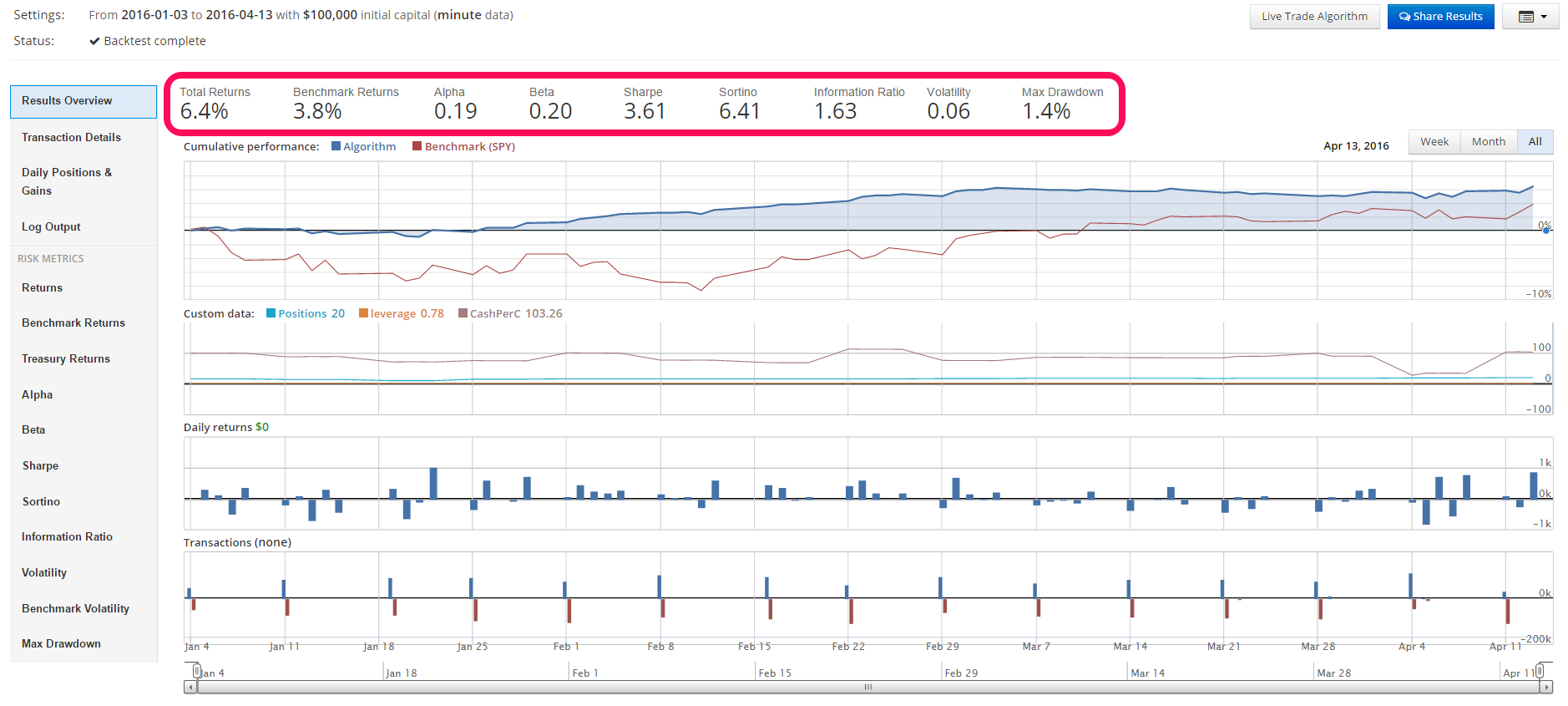
To see the origin of this series click here. To summarize, the strategy calculates a SKEW measure using ATM calls and OTM puts for a collection of ETF symbols. It then sorts the symbols into quintiles based on the SKEW factor. Using daily close/close log return calculations for this strategy has shown exceptional performance as can be seen here. However, translating a successful daily strategy with no transaction costs and perfect trading fills into a robust strategy that can execute and perfo

READ MORE
A Dead Simple 2-Asset Portfolio that Crushes the S&P500 (Part 2)
PythonQuant

A Dead Simple 2-Asset Portfolio that Crushes the S&P500 (Part 2)

In Part 1, and Part 1.5 I introduced a simple 2-asset portfolio that substantially outperformed the SPY ETF since 2009. In Part 1 I examined the performance of an "inverse risk-parity" approach where the ETF with the largest volatility contribution to the portfolio was weighted more heavily. In Part 1.5 I examined the performance of the actual "risk-parity" approach, where the ETF with the smallest volatility contribution is weighted more heavily. In this post I will examine some of the conceptu

READ MORE
A Dead Simple 2-Asset Portfolio that Crushes the S&P500 (Part 1.5)
PythonQuant

A Dead Simple 2-Asset Portfolio that Crushes the S&P500 (Part 1.5)

In Part 1 of this series I shared a simple strategy which showed outsized performance relative to the SPY ETF since 2009. I made a small error in the implementation. The previous portfolio was not rebalanced according to a risk-parity framework. It was actually the inverse. The strategy was rebalanced such that the ETF responsible for the highest percentage of the portfolio's volatility was weighted more heavily! Surprisingly this error did nothing to substantially alter the performance of the p

READ MORE
USING IMPLIED VOLATILITY TO PREDICT ETF RETURNS (4/09/16)
PythonQuant

USING IMPLIED VOLATILITY TO PREDICT ETF RETURNS (4/09/16)

FOR A DEEPER DIVE INTO ETF PERFORMANCE AND RELATIVE VALUE SUBSCRIBE TO THE ETF INTERNAL ANALYTICS PACKAGE HERE To see the origin of this series click here In the paper that inspired this series "What Does Individual Option Volatility Smirk Tell Us About Future Equity Returns" the authors' research shows that their calculation of the Option Volatility Smirk is predictive of equity returns up to 4 weeks. Therefore, each week, I will calculate the Long/Short legs of a portfolio constructed by fol

READ MORE