Post Outline
- Purpose
- Intuitive explanation
- Code
- Next Steps
Purpose
This is a simple reference article for readers that might wonder where I get/got my options data from. In this regard I would like to shout out the contributors to the pandas-datareader, without their efforts this process would be much more complex.
Intuitive Explanation
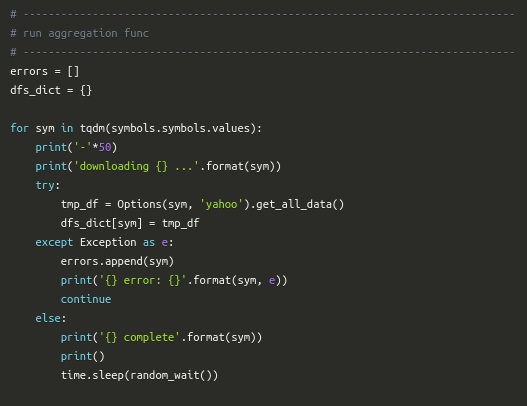
So this code consists of three components. The first is the actual script that wraps the pandas-datareader functions and downloads the options data. The second is a helper script to save the aggregated data to disk. The helper script which I call file_handler is designed to save the data in multiple formats in a structured file directory. Internally it checks to see if today's folder is created with a particular date and naming convention, if it isn't it will create the folder and then store all the data files there. What gives this code the ability to aggregate intraday data is the third component which simply requires making use of your system's task scheduler. For example, if you have Linux/Ubuntu you can package this script to run as a cronjob quite easily. After the code below I show an example cronjob template that works.
Code
This is the code for the file_handler script. It can save in 1 of the following 4 formats: parquet, h5, feather, csv. I save the list of symbol errors as a CSV since this list is generally quite small. As seen above I save the options data in parquet format first, and a backup in the form of an h5 file. Generally I prefer to work with parquet files because the are compressed by default, contain metadata, and integrate better with the Dask. This code requires the installation of the pyarrow package.
Finally, below is an example of my cronjob. It is set to run Monday through Friday, hourly, from market open to close. Note the log directory and log file after the ">>"; all the print statements contained in the script will output to that log file including any exceptions.
30 7-15 * * 1-5 /YOUR/CODE/DIR/option_skew_project/scripts/options_downloader.py' >> /YOUR/LOG/DIR/options_downloader_cronlog.log 2>&1
Next Steps
The next article will document the code I refactored to calculate the option skew metric from the paper "What Does Individual Option Volatility Smirk Tell Us About Future Equity Returns" by Yuhang Xing, Xiaoyan Zhang and Rui Zhao. If you have been a long time reader, you may recall I did a series where I tracked a theoretical ETF equity strategy that was based on this metric. Over time, people have asked how it is performing, and I did not have an answer because I stopped tracking it, as I have been busy with other projects. However, the strategy showed promise then and I wondered if it could be applied directly in options trading. My goal is to research the possibility of implementing this strategy live, and if the results show an edge, implementing it and tracking the results publicly.
To accomplish this task I first needed to gather data which this article shows. In the next article I make heavy use of Dask because the volume of intraday data aggregated over a month is over 14 million rows and operating on the dataframe in-memory is slow and/or unfeasible on most people's systems including mine.
Additionally the next article will be a jupyter notebook I will embed as a blog post here directly, but recommend it be viewed on the github repo I will make public.